

Table of Contents
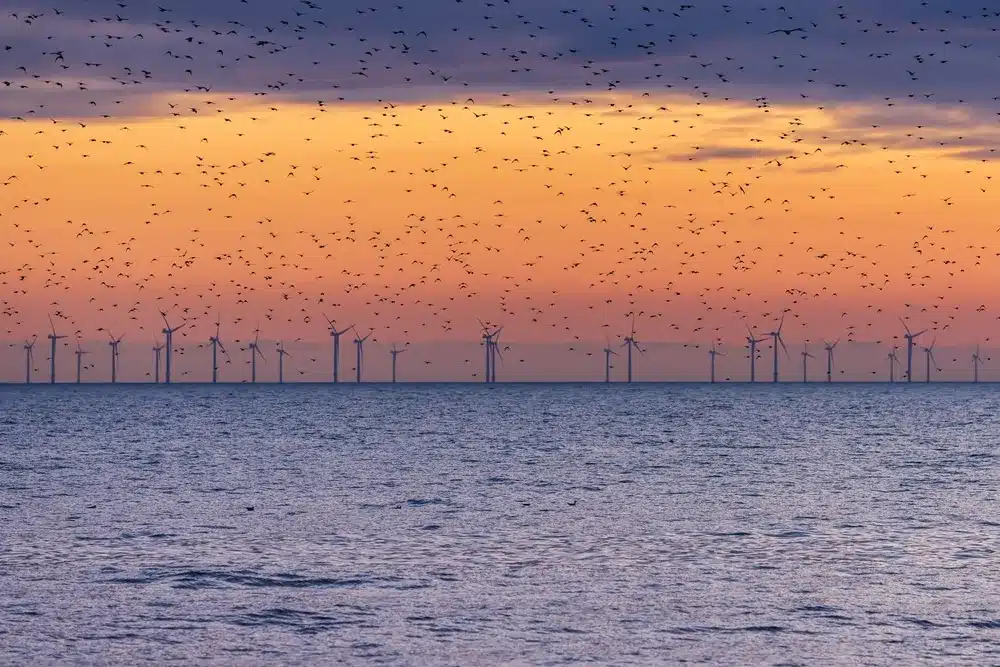
Negros Occidental is set to host 11 wind farm projects along its coastline facing the Guimaras Strait, a known route for migratory birds. The projects, spread across 11 cities and municipalities, are planned to generate a combined 3,767 megawatts (MW) of electricity, with operations targeted between 2027 and 2030.
The proposed wind projects in Negros Occidental will include both onshore and offshore facilities, according to Rafael Coscolluela, a provincial consultant on energy and environmental issues.
He explained that proponents must undergo lengthy procedures to secure an environmental impact assessment (EIA) and an environmental compliance certificate (ECC) from the Department of Environment and Natural Resources (DENR).
To reduce the risk to migratory birds along the Guimaras Strait, Coscolluela said proponents had initially agreed to paint turbine blades in bright colors to make them easier for birds to see.
But as the province turns to renewable energy (RE), concerns are growing over its possible effects on wildlife, especially because Negros Occidental is home to the Negros Occidental Coastal Wetlands Conservation Area, a wetland recognized internationally for its ecological importance. Covering nearly 90,000 hectares of coastal areas, mangroves and waters, it provides an important habitat for wildlife.
Other than risks to migratory birds, wind farms can lead to habitat loss and fragmentation when land is cleared for turbine foundations, access roads and transmission lines. Construction activities, particularly on steep or environmentally sensitive terrain, can also cause soil erosion and sediment runoff, potentially affecting nearby rivers and other waterways.
Offshore wind farms present additional concerns, as construction noise and other activities can disturb marine mammals and other marine organisms, depending on the site and construction methods.
Finally, the cumulative environmental impacts of multiple wind projects can be significant. When several developments are built within the same region, their combined effects may result in greater habitat loss, wildlife disturbance, and pressure on ecosystems than assessments of individual projects reveal.
(Also read: Relief in Sight? ERC Halts Expensive Reserve Market to Curb Power Costs)
Negros’ RE Push Faces Growing Questions
The Visayas has been grappling with a power crunch since May, with tight energy reserves continuing to threaten grid stability.
The latest warning of tightening power reserves was on October 22, when the National Grid Corporation of the Philippines (NGCP) placed the Visayas grid under red and yellow alerts due to the unavailability of major coal-fired power plant units and reduced electricity imports from Mindanao.
A red alert signals that available power supply is no longer sufficient to meet consumer demand and the grid’s regulating requirements. A yellow alert, meanwhile, indicates that the operating margin has fallen below the level needed to meet contingency requirements, leaving the grid with a limited buffer against unexpected supply disruptions.
The Department of Energy (DOE) acknowledged a shortage of baseload power in the Visayas, leaving the region struggling to keep pace with rising electricity demand.
DOE Secretary Sharon Garin said additional generation capacity is needed to shore up supply, warning that the shortfall could persist until 2028. She noted that the grid’s reliance on limited generating capacity means even the loss of one plant can prompt an alert.
Negros, in particular, emerged as Garin’s key example of this supply challenge, generating surplus electricity during the day largely from solar power, only to see output decline as the sun sets and demand climbs in the evening. The pattern is reflected in power alerts declared during the late afternoon and early evening, when declining solar output coincides with rising electricity demand.
“Where then will the electricity come from at night?” Garin pointed out. “Negros alone cannot survive because there is not enough baseload.”
Negros ranks third in electricity demand across the Visayas, accounting for 18% of the region’s total consumption, closely trailing Panay’s 21%. The province’s substantial share underscores its significant power requirements, with demand surpassed only by Cebu, which accounts for 42%.
Negros Oriental formalized its commitment to RE in January 2022, declaring itself a clean-energy province and adopting what was described as the Philippines’ first local Clean and RE Code. The measure governs power generation, transmission, and distribution projects, with a central provision prohibiting the construction of fossil fuel-fired power plants. Reversing the ban requires a public referendum initiated by residents, followed by approval from the provincial board and governor.
Beyond restricting fossil fuels, the code seeks to attract RE investments through streamlined permitting and incentives. It also establishes a provincial RE council and provides for carbon credit revenues to be shared equally between the provincial government and the local government hosting a project. The ordinance secured unanimous approval from the provincial board, despite political differences among its members.
Negros Occidental’s opposition to coal was already taking shape in 2019, when then-Gov. Alfredo Marañon Jr. issued an executive order declaring the province coal-free. The move followed public and church-led resistance to a proposed 300-MWcoal-fired power plant in San Carlos City.
Despite their RE commitments, Negros Occidental and Negros Oriental still rely heavily on fossil-fueled power generated outside the island. Research by the Center for Energy, Ecology, and Development (CEED), published in 2022, showed that coal and diesel together accounted for 73% to 80% of electricity consumed by captive customers on the island.
This dependence has also fueled debate over the island’s restrictions on conventional power generation. Cebu-based advocacy group Cebu Energy Rights Advocates (CERA) argues that bans on coal and diesel plants in Negros and Bohol have shifted part of their baseload requirements to neighboring provinces, including Cebu, Panay and Leyte. The group is calling on local leaders to reconsider the restrictions, warning that the arrangement adds pressure to an already strained Visayas power grid.
“Demand for power is shared by one Visayas grid,” asserted CERA convenor Nathaniel Chua. “Therefore, the responsibility for the burden of baseload supply must also be shared.”
Although Negros has more than 950 MW of installed generating capacity, Chua said much of it comes from solar facilities, whose output declines after sunset. Additionally, Negros has only about 240 MW of baseload capacity from the Palinpinon geothermal plants, well below its peak demand of around 450 MW.
“Negros walang baseload except for isang geothermal. Puro renewable—solar. Kulang conventional plants (Negros has no baseload capacity except for one geothermal plant. It relies mostly on renewables—solar. There are not enough conventional plants),” DOE Undersecretary Mario Marasigan emphasized. “Pag may planta na nag-outage, kulang na po tayo (When a plant goes offline, we don’t have enough power).”
(Also read: Cebu Energy Alliance Presses For Power Crisis Solutions)
Negros’ Power Challenge Demands Action
Negros’ recurring power shortages raise questions about whether its existing energy policies adequately address the province’s electricity needs. Despite years of promoting RE and restricting fossil-fuel development, the island remains dependent on power generated elsewhere in the Visayas. The vulnerability becomes clear when major generating units go offline and solar output declines, leaving limited reserves to meet demand. These conditions call for a reassessment of whether current policies are delivering the reliability the province needs.
Environmental protection must also be part of this review. A green-energy policy should account not only for the electricity a project can produce, but also for its effects on the natural environment and the communities around it.
Negros’ commitment to cleaner energy need not be abandoned, but it should not be beyond scrutiny. As power alerts and supply constraints persist, provincial leaders must be willing to revisit their assumptions, address the baseload gap and weigh the practical consequences of their policies.
Ultimately, the success of the province’s energy transition will depend not on how green its commitments appear on paper, but on whether its electricity system can reliably serve its people while developing its economy.
Sources:
https://www.nature.com/articles/s44358-025-00078-1
https://www.fws.gov/sites/default/files/documents/FWS-national-land-based-wind-energy-guidelines.pdf
https://insiderph.com/doe-backs-exceptions-to-coal-ban-amid-visayas-power-woes
https://energy.com.ph/negros-oriental-enacts-phs-first-renewable-energy-code
https://oxfam.org.ph/the-irony-of-negros-islands-abundant-renewable-energy/