

Table of Contents
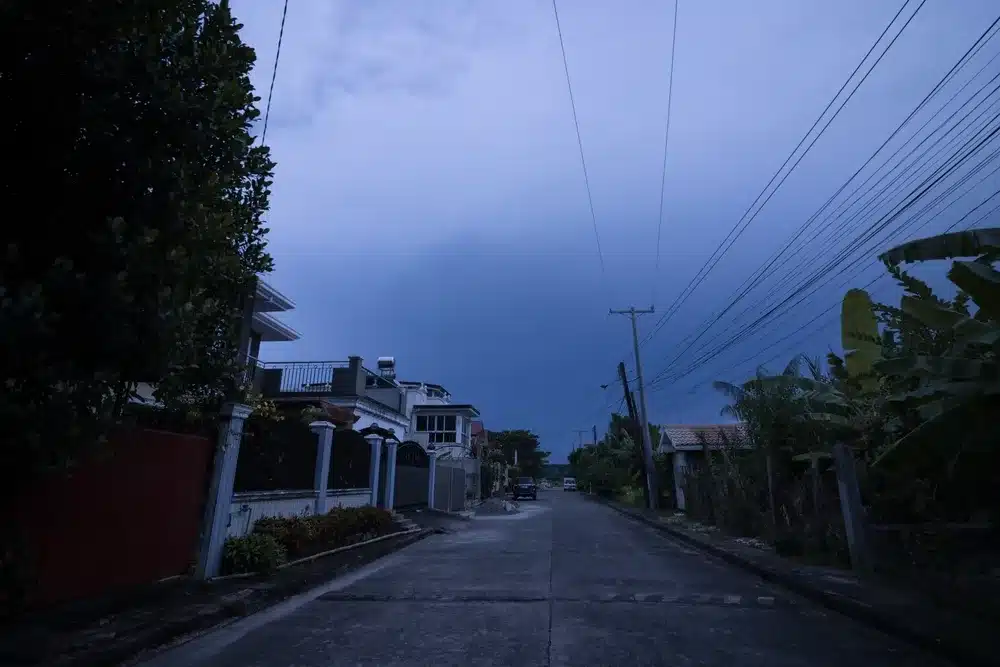
Last November 5, Department of Energy (DOE) Undersecretary Felix William Fuentebella reported that about 1.4 million Visayas households lost power as Typhoon Tino’s strong winds and heavy rains battered the region.
According to the Philippine News Agency (PNA), eight electric cooperatives (ECs) reported total power loss in the morning of November 4 as the typhoon struck. Meanwhile, the National Electrification Agency (NEA) assured fuel support for hospitals and other vital facilities using backup generators.
NEA added that its Disaster Risk Reduction and Management Department (DRRMD) identified the ECs that eported total power outages: Bantayan Electric Cooperative (BANELCO), Biliran Electric Cooperative (BILECO), Cebu II Electric Cooperative (CEBECO II), Cebu III Electric Cooperative (CEBECO III), Camotes Electric Cooperative (CELCO), Eastern Samar Electric Cooperative (ESAMELCO), Leyte II Electric Cooperative (LEYECO II), and Leyte III Electric Cooperative (LEYECO III).
At the time, 423 of 681 municipalities, roughly 62% of areas served by ECs, were still awaiting power restoration, affecting about 3,016 villages and over one million customers. NEA Administrator Antonio Mariano Almeda said repair and restoration efforts were already in progress.
(Also read: EDC Revamps Leyte Site to Power Next-Gen Renewables)
Damaged transmission lines
In a report released on November 5, the National Grid Corporation of the Philippines (NGCP) said power had been restored along the Paranas–Quinapondan 69-kilovolt (kV) line, but 19 transmission lines across the Visayas and Mindanao were still out of service.
Among those affected were the Maasin–Baybay 69-kV line supplying LEYECO IV; the Ormoc–San Isidro and Maasin–San Isidro 69-kV lines serving several ECs, including the Don Orestes Romualdez Electric Cooperative (DORELCO), Southern Leyte Electric Cooperative (SOLECO), LEYECO III, LEYECO V, and the Biliran Electric Cooperative (BILECO).
Also offline were the Calongcalong–Asturias, Compostela–Consolacion, and Compostela–Carmen 69-kV lines supplying Cebu’s CEBECO II and III, and the Nabas–Culasi–Bugasong 69-kV line serving the Antique Electric Cooperative (ANTECO).
In Negros, the Amlan–San Carlos 69-kV line affecting Negros Oriental Electric Cooperative (NORECO I) and II, as well as the Bacolod–San Enrique and Bacolod–Silay–Victorias 69-kV lines catering to the Negros Electric and Power Corp. (NEPC) and the Negros Occidental Electric (NOCECO), were also reported down. The NGCP added that seven 138-kV and two 230-kV lines remained unavailable, though specific details were not disclosed.
Repair teams have been deployed to inspect and restore the damaged facilities, with simultaneous restoration work ongoing in areas already accessible.
(Also read: Cebu’s Bright Future Faces Twin Shocks: Quake & Power Woes)
Extreme rainfall in Cebu
According to a report from PAGASA, Typhoon Tino unleashed intense rainfall across the Visayas, triggering severe flooding in Cebu province.
Data from the Mactan weather station in Lapu-Lapu City and an automatic rain gauge in Danao City showed 183 millimeters of rain fell between 8 a.m. on November 3 and 8 a.m. on November 4. This is roughly equivalent to 180 liters of water pouring over every square meter of land.
PAGASA noted that this single-day rainfall nearly matched six weeks’ worth of Cebu’s usual precipitation.
The weather bureau said the rainfall in Cebu exceeded levels usually experienced only once every 20 years, indicating just a five percent chance of similar or heavier rain occurring in any given year.
The heavy downpour unleashed by Typhoon Tino caused rivers to overflow, sending torrents of water rushing through streets and residential areas in the cities of Danao, Cebu, Mandaue, and Talisay, as well as the towns of Liloan, Compostela, and Consolacion. Deadly flooding was also reported across Negros, Panay, and Palawan.
The typhoon made eight landfalls before exiting the Philippine Area of Responsibility.
Death toll climbs to 188
The National Disaster Risk Reduction and Management Council (NDRRMC) reported that the death toll from the typhoon had risen to 188.
Most of the fatalities were recorded in Cebu with 139 deaths, followed by 24 in Negros Occidental, nine in Negros Oriental, six in Agusan del Sur, three in Capiz, two in Southern Leyte, and one each in Antique, Bohol, Iloilo, Leyte, and Guimaras. The NDRRMC noted that only the fatality reported in Leyte has been officially confirmed.
Authorities said the casualty figures remain under validation and may still change.
According to the latest NDRRMC data, Typhoon Tino affected 635,565 families, or about 2.26 million people, across 5,535 barangays in eight regions.
At least 88,649 families were staying in 3,050 evacuation centers, while 23,350 others received assistance outside designated shelters. The storm also damaged 9,321 houses, of which 264 were completely destroyed.
Sources:
https://business.inquirer.net/556536/typhoon-tino-causes-power-outages-for-1-4m-households